
Hustler Words – Netflix, the streaming giant credited with popularizing the "binge-watching" phenomenon, now faces a critical juncture where its signature model appears to be losing its luster. A recent Bloomberg report, drawing on internal Netflix data, reveals a concerning trend: a significant number of subscribers are abandoning popular series before their second seasons. This shift points to deeper issues within the platform’s content strategy and a dramatic evolution in how audiences consume entertainment.
The reasons behind this viewer attrition are largely anticipated. Frequent show cancellations by Netflix, coupled with lengthy hiatuses between seasons, contribute to viewer fatigue. Furthermore, a perception exists that much of Netflix’s content is engineered to satisfy algorithmic demands rather than to deliver compelling artistic narratives.
However, the implications extend beyond mere content woes. This data signals a fundamental change in the digital entertainment landscape. Netflix’s defining innovation – the ability to consume an entire season at once – was a game-changer when its primary competitor was traditional linear television. Today, the battlefield has shifted, with Netflix now contending with the likes of TikTok, YouTube, Instagram Reels, and a burgeoning array of microdrama applications. In this new paradigm, the binge model, once revolutionary, now risks feeling like an outdated relic.

Related Post

The Binge: A Victorious Strategy Against Old TV
When Netflix unleashed the full first season of "House of Cards" in February 2013, it was nothing short of a revelation. The ad-free, on-demand nature of internet-connected television liberated viewers from the rigid schedule of weekly episodes punctuated by commercials. Bingeable series fostered rapid, intense connections between viewers and characters, relationships that would have traditionally taken years to cultivate. The freedom to watch anytime, anywhere, was a stark contrast to the fixed programming of broadcast networks.
This strategy proved immensely successful in an era dominated by traditional broadcast, cable, and satellite television. Indeed, Netflix largely won that battle. By June 2025, Nielsen data confirmed a monumental milestone: streaming, largely driven by the Netflix-style format, for the first time surpassed traditional broadcast and cable viewership. This achievement unequivocally demonstrated that Netflix’s original competition was no longer the primary threat.
Yet, Netflix’s current adversaries are not the television networks of yesteryear, but rather the dynamic, short-form video platforms that define contemporary digital entertainment.
TikTok and YouTube: The New Titans of Attention
The meteoric rise of TikTok, Reels, and similar short-form video platforms has fundamentally altered consumer expectations. When seeking quick, mindless entertainment, users now have an endless, free supply of content at their fingertips, often negating the need to navigate to Netflix.
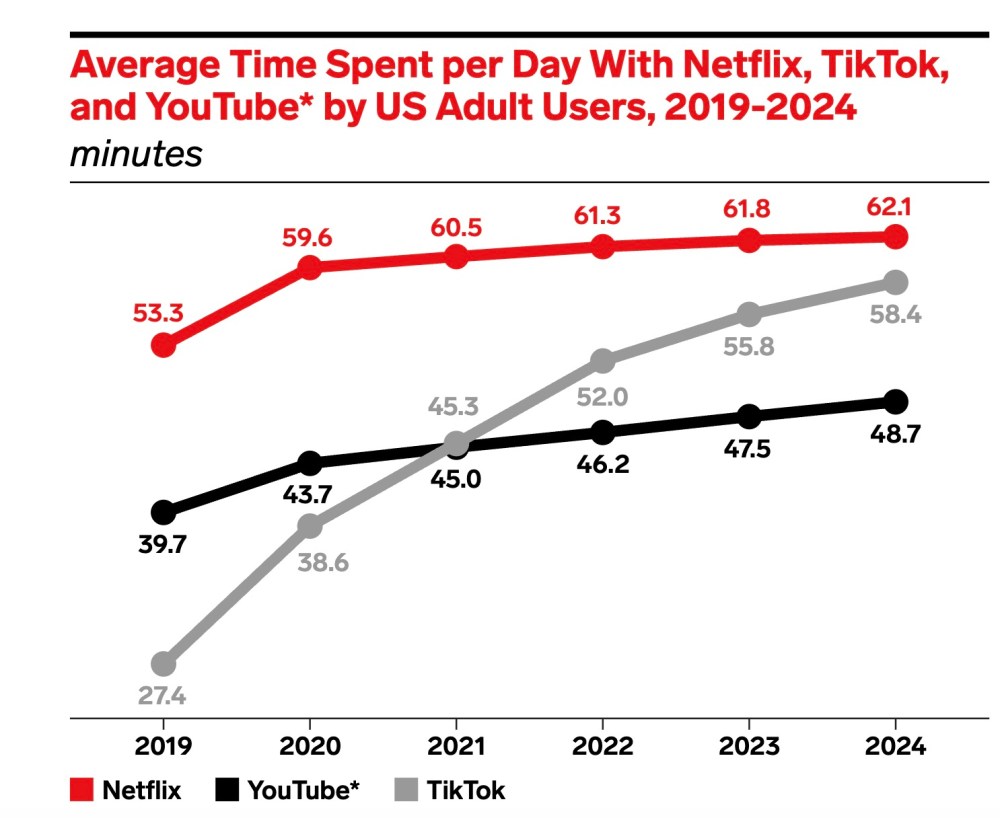
eMarketer analysts noted that by 2024, TikTok was already closing in on Netflix in terms of daily time spent. U.S. adults were dedicating an average of 62.1 minutes per day to Netflix streaming, closely followed by 58.4 minutes on TikTok. Globally, the Financial Times reported that TikTok users spent an average of 95 minutes daily on the app in 2024, boasting the highest engagement rate among major social networks.
Then there’s YouTube, a hybrid platform offering both short and longer-form content. A recent report from Digital i highlighted that YouTube surpassed Netflix in average daily viewing for the first time in 2025, with users spending 99.1 minutes daily on the platform compared to Netflix’s 93.4 minutes.
While these market reports employ varying methodologies and demographics, and thus should be interpreted with a degree of caution, their directional consensus is clear: YouTube and apps like TikTok represent Netflix’s true competitive landscape, not traditional television.
Netflix itself has acknowledged this existential challenge, evidenced by its April product redesign which introduced a TikTok-esque feed populated with Netflix content. However, this feed is primarily positioned as a discovery tool to help users find something to watch, rather than being the destination content itself. While understandable given Netflix’s vast library, this approach may not align with the desires of today’s dopamine-drained attention spans, which increasingly gravitate towards microdrama apps for serialized storylines consumable in minutes.
The Rise of Microdramas
Data from app intelligence firm Appfigures underscores the explosive growth of microdrama platforms. ReelShort, a leading app in this segment, recorded approximately $1.2 billion in gross consumer spending in 2025, a remarkable 119% increase from 2024, as previously reported by Amanda Silberling on Hustler Words. Similarly, DramaBox, another prominent app, generated $276 million in gross consumer spending last year, more than doubling its 2024 figures. Even TikTok has entered the fray, launching its own microdrama app to gauge market appetite.
Netflix’s Crossroads: What’s Next?
This leaves Netflix, whose claim to fame was the instant drop of full seasons for rapid consumption, at a critical juncture. The platform will likely need to fundamentally re-evaluate how it greenlights, produces, and releases what it traditionally defines as a "TV show."
This doesn’t necessitate a complete pivot to short-form content to keep pace. However, Netflix must reconsider contemporary streaming preferences. Viewers may no longer be willing to commit hours and weeks to navigate multi-season narratives, instead seeking content that feels more "finishable," akin to a YouTube video series or a TikTok saga.
A straightforward solution could involve prioritizing single-season shows, often known as miniseries or limited series. This would allow viewers to engage with a complete narrative arc without the anxiety of potential cancellations or unresolved cliffhangers. Netflix could also explore segmenting shows into shorter, more digestible chunks, reminiscent of the ill-fated Quibi model. Quibi, a Jeffrey Katzenberg-backed startup, had bet on short-form content consumption, but its timing was unfortunate, launching just as the pandemic drove audiences towards longer-form viewing.
Many existing Netflix shows, particularly lightweight competition formats like "Nailed It," "Is It Cake?", or "Squid Game: The Challenge," could be easily adapted for shorter viewing sessions. Furthermore, Netflix possesses the resources to produce higher-quality microdramas than the often-critiqued offerings currently dominating the market.
To re-ignite interest in its premium content, Netflix could also selectively reintroduce a weekly release model, a strategy it has successfully deployed in specific instances. For example, its reality hit "Love Is Blind" benefits from weekly episode drops, generating "watercooler" buzz as audiences collectively engage with new installments. (Even faster consumption models, like Peacock’s near-daily "Love Island USA," demonstrate alternative successful approaches.)
However, instead of experimenting with diverse short-form content, strategic slower releases for certain seasons, or a heavier focus on compelling miniseries, Netflix has recently diversified into other ventures. Its expansion into podcasts has reportedly seen limited traction, and its foray into live content has yielded mixed results. While investments in live sports have generally performed well, its recent live reality competition, "Star Search," was swiftly canceled despite innovative real-time voting features, indicating a need for further refinement.
The Bloomberg report frames Netflix’s challenge as a failure to cultivate loyal multi-season viewers. Yet, the underlying issue is far broader. Netflix must decide whether its future lies in competing with traditional television’s long-running sagas, or if it should pivot towards entertainment projects with tighter storytelling, less filler, and quicker resolutions.
Caught between audiences abandoning cable and those seeking more engaging alternatives to TikTok, Netflix finds itself in the complex position of needing to reinvent the very concept of television once again.




Leave a Comment