
Hustler Words – India, WhatsApp’s most expansive market, is currently presenting the Meta-owned messaging giant with its most formidable challenge yet. Recent governmental directives are poised to fundamentally alter how millions of Indian citizens and countless small businesses interact with the ubiquitous platform daily, sparking widespread concern over potential disruptions to digital life.
Late last month, the Indian government unveiled new mandates, publicly disclosed earlier this December, that demand specific app-based communication services maintain continuous links between user accounts and active SIM cards. Furthermore, these regulations impose stringent controls on how these applications operate across multiple devices, signaling a significant shift in digital oversight.
New Delhi asserts that these measures are crucial for combating the escalating wave of cyber fraud plaguing the nation, which is now the world’s most populous. The telecom ministry highlighted that India has already incurred cyber-fraud losses exceeding ₹228 billion (approximately $2.5 billion) in 2024 alone. The government clarified that these rules do not apply when a SIM card remains within its device and the user is roaming internationally.

Related Post

However, a chorus of digital advocacy organizations, policy experts, and industry associations—including Meta itself—has voiced strong reservations. They warn that this regulatory approach risks significant overreach and could severely impede legitimate usage, particularly in a country where WhatsApp has become deeply embedded as essential infrastructure for both personal communication and small-scale commerce.
The directives, which messaging providers like Meta, Telegram, and Signal must implement within 90 days of their November 28 issuance, specifically require apps to remain tethered to the SIM card used during initial sign-up. Additionally, web and desktop versions of these applications will necessitate users to log out every six hours, requiring a re-linking via a QR code to regain access.
While these regulations broadly encompass major instant messaging applications, their repercussions are expected to be most acutely felt by WhatsApp, which boasts over 500 million users in India. The app’s penetration in the country is exceptionally deep; data from Sensor Tower, as shared with Hustler Words, indicates that an astounding 94% of WhatsApp’s Indian monthly user base engaged with the app daily in November. Similarly, 67% of WhatsApp Business users in India accessed the platform daily, starkly contrasting with the U.S. figures of 59% for general users and 57% for Business users.
This impending disruption poses a particular threat to India’s vast ecosystem of small merchants. Many of these businesses rely on the WhatsApp Business app, a smartphone-centric version designed for small enterprises. They typically register their accounts on a SIM-linked phone but manage customer interactions through WhatsApp’s web or desktop client on a separate device. Unlike larger corporations that leverage WhatsApp’s Business APIs for automated, CRM-integrated communication, these smaller ventures directly engage customers via the WhatsApp Business app and its companion web interface. Consequently, mandatory SIM binding and frequent forced logouts could severely cripple essential workflows for order processing, customer support, and engagement.
The timing of these Indian mandates is particularly noteworthy, as WhatsApp has been actively expanding its multi-device and companion-device functionalities globally. This strategic push aims to enable users and businesses to maintain seamless logins across various phones, browsers, and devices without being tied to a single active smartphone, a vision now directly challenged in its largest market.
The directives also arrive as WhatsApp undergoes a significant strategic shift in India, its primary growth now stemming from user retention rather than rapid new user acquisition. Sensor Tower data, reported by Hustler Words, reveals that WhatsApp’s monthly active users (MAU) on mobile devices in India have increased by 6% year-over-year in the fourth quarter to date, even as new downloads have plummeted by nearly 49%. Compared to late 2022, India’s WhatsApp MAU has risen by 24%, while downloads have decreased by 14% over the same period.
"It’s reasonable to conclude that WhatsApp’s MAU growth in India over the past few years has been predominantly driven by successful re-engagement of existing or previous users, rather than the acquisition of new ones," noted Abraham Yousef, a senior insights analyst at Sensor Tower.
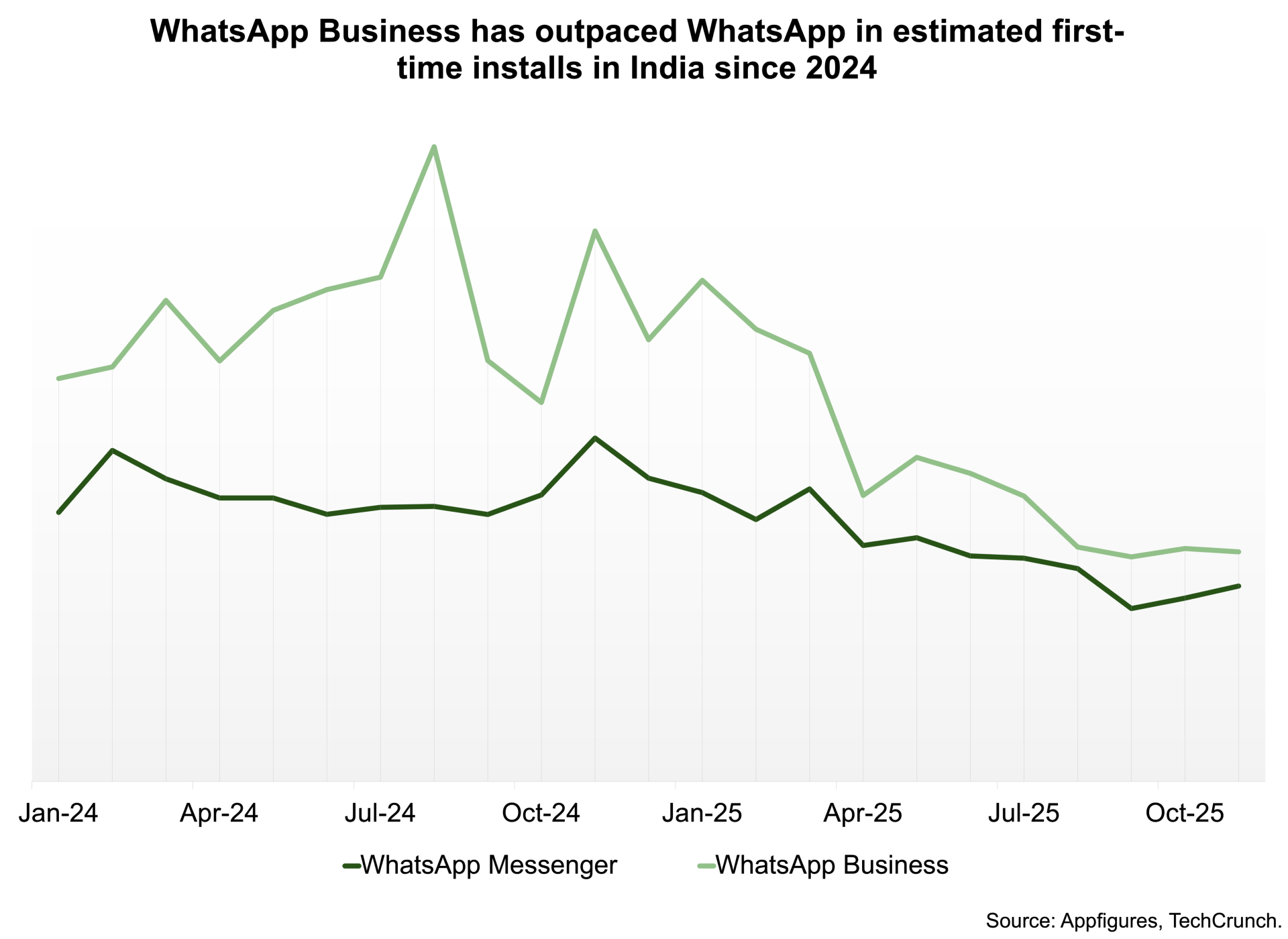
Further insights from Appfigures illustrate that WhatsApp Business has consistently recorded more estimated first-time installs than WhatsApp Messenger in India since early 2024. This trend underscores how merchant adoption is increasingly fueling growth, rather than broad-based consumer expansion. Randy Nelson, head of insights at Appfigures, explained that it is common for Indian merchants to maintain distinct WhatsApp identities for personal and customer communications, often facilitated by dual-SIM phones, with a single business potentially generating multiple installs across staff and shop devices.
Sensor Tower data reinforces this pattern, showing WhatsApp Business MAU in India still growing year-over-year in late 2025 and surging over 130% compared to 2021, significantly outpacing WhatsApp Messenger’s approximately 34% growth during the same timeframe. While overall engagement remains higher on WhatsApp Messenger—with Indian users spending an average of 38 minutes daily in November compared to 27 minutes on WhatsApp Business—the U.S. market presents a different picture, where users spent about 23 minutes daily on WhatsApp and 27 minutes on WhatsApp Business, according to Sensor Tower estimates.
The Broadband India Forum (BIF), an industry body counting Meta among its members, issued a statement last week expressing "serious questions of technical feasibility" regarding India’s new directives. The BIF warned that these measures could lead to "material inconvenience and service disruption on ordinary users."
Kazim Rizvi, founding director of The Dialogue, a New Delhi-based public policy think tank, highlighted that these directives hinge on a novel and contentious classification of Telecommunication Identifier User Entities (TIUEs) under India’s telecom cybersecurity rules. This effectively re-categorizes messaging apps within a telecom framework—a departure from their traditional regulation under the country’s IT Act—achieved through executive directions rather than formal legislation.
"The directives derive their authority not from statute but from delegated legislation," Rizvi informed Hustler Words. "Moreover, the absence of public consultations or technical working groups risks generating significant compliance friction without adequately addressing the underlying fraud vectors." The Indian telecom ministry did not respond to requests for comment.
For the immediate future, companies like Meta face limited avenues to challenge these directives in court, according to technology policy experts. Dhruv Garg, a tech policy advisor and partner at the Indian Governance and Policy Project, explained that challenging such directives typically requires demonstrating either that they exceed the scope of the underlying law or that they violate constitutional protections—a high legal bar that may prove difficult to meet in this particular instance. Meta declined to comment on this developing situation.



Leave a Comment