
Hustler Words – Near the vibrant San Francisco pier, Sam Altman’s ambitious identity verification initiative, World, recently unveiled its expansive vision for the future of digital authenticity. The project, spearheaded by Tools for Humanity (TFH), is poised for significant growth, with a notable initial focus on integrating its verification technology into the popular dating application, Tinder.
The announcement on Friday detailed plans to embed World’s innovative verification solutions across a broad spectrum of digital interactions, including dating platforms, event ticketing, corporate environments, email services, and various other public-facing online arenas. This strategic expansion comes at a critical juncture, as the digital landscape grapples with the proliferation of advanced AI.
"The world is rapidly approaching an era of incredibly powerful AI, which is bringing forth many remarkable advancements," Altman stated to a captivated audience at The Midway. He further elaborated on the impending reality where AI-generated content will likely surpass human-created material. "I’m certain many of you have experienced moments where you question whether you’re interacting with an AI or a person, or a blend of both, and how to discern the difference."

Related Post
World, formerly known as Worldcoin, distinguishes itself in the crowded field of ID verification by offering a unique proposition: confirming the presence of a genuine, living human user while meticulously safeguarding their anonymity. This intricate process is underpinned by sophisticated cryptographic techniques, specifically "zero-knowledge proof-based authentication." The core objective is to develop "proof of human" mechanisms – tools designed to validate human activity in an online ecosystem increasingly populated by autonomous AI agents and bots.
The cornerstone of World’s verification system is the Orb, a distinctive spherical digital scanner. This device captures a user’s iris pattern, transforming it into a unique, anonymous cryptographic identifier known as a verified World ID. This ID then serves as a gateway to World’s services, though users can also access the World app without undergoing Orb verification.
Altman’s address on Friday was concise, with much of the presentation duties later handed over to World’s chief product officer, Tiago Sada, and his team, due to the absence of TFH’s co-founder and CEO, Alex Blania, who was recovering from a last-minute hand surgery.
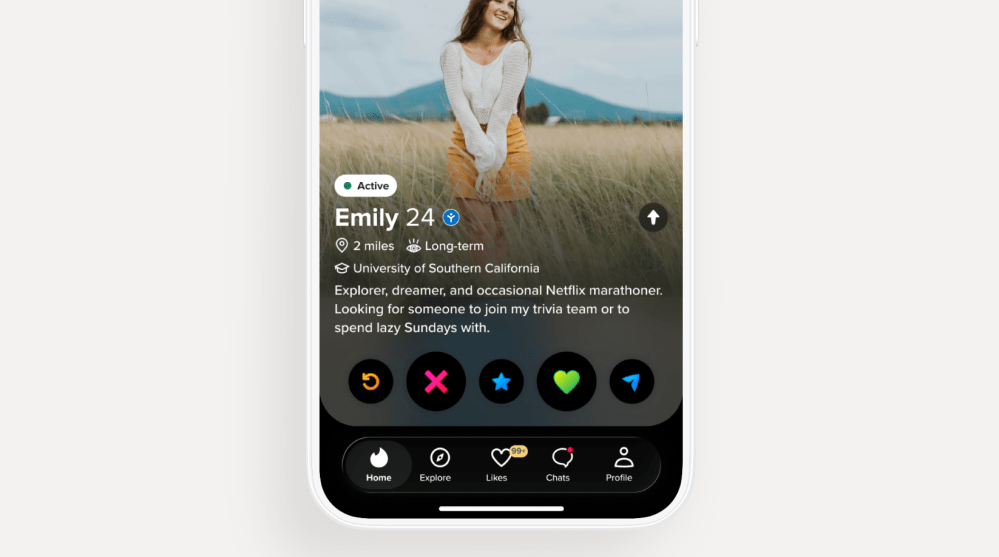
Sada introduced the latest iteration of the World app, an upgrade from its December launch, alongside a suite of new technological integrations. A significant focus was placed on dating apps, particularly Tinder. Following a successful World ID pilot program in Japan last year, Tinder is now set to roll out this verification integration globally, including in the United States. This initiative will display a World ID emblem on the profiles of verified users, providing an authenticating mark of their genuine human identity.
Beyond romance, World is also making inroads into the entertainment sector with its new "Concert Kit." This feature allows musical artists to allocate a specific number of concert tickets exclusively for World ID-verified individuals. The aim is to protect fans from predatory scalpers who often deploy automated bots to snap up tickets. Concert Kit is designed for compatibility with major ticketing platforms like Ticketmaster and Eventbrite, and it’s being promoted through partnerships with artists such such as 30 Seconds to Mars and Bruno Mars, both of whom plan to utilize it for their upcoming tours.
The event also featured several announcements targeting the business world. A new Zoom/World ID verification integration seeks to combat the emerging threat of deepfakes in business calls, while a partnership with Docusign aims to ensure that digital signatures originate from authentic users.
Anticipating the evolving "Wild West" of the agentic web, the company is also developing features like "agent delegation," which allows individuals to assign their World ID to an AI agent for specific online tasks. A collaboration with authentication giant Okta has resulted in a beta system that verifies an agent’s authority to act on behalf of a human. As Gareth Davies, Okta’s chief product officer, explained at the event, this system links a World ID to a particular agent, allowing websites to confirm that a verified human is behind the agent’s online actions.
Historically, World has faced challenges in scaling its operations, primarily due to the verification process itself. For a considerable period, achieving the gold standard of verification necessitated a visit to one of World’s offices for an Orb eye scan – an experience often described as inconvenient and somewhat unusual.
However, World has been proactive in enhancing the accessibility and incentives for verification. In the past, it offered its crypto asset, Worldcoin, to early adopters and has strategically placed Orbs in major retail chains, enabling users to verify themselves during routine shopping or coffee breaks. The company is now significantly expanding its Orb presence in key metropolitan areas like New York, Los Angeles, and San Francisco. Additionally, World has introduced a service where an Orb can be brought directly to a user’s location for remote verification.
In a conversation with hustlerwords.com, Sada elaborated on World’s multi-tiered approach to solving the scaling dilemma. The Orb verification remains the highest tier. Below this, World previously offered a mid-level tier involving an anonymized scan of an official government ID via its NFC chip.
The company has now introduced a new "low-friction" tier, as Sada described it, which implies minimal effort but also "low security." This tier simply requires taking a selfie.
"Selfie Check," presented by Sada’s team during the event, is engineered with user privacy at its core. Daniel Shorr, an executive at TFH, emphasized during the presentation, "Selfie is private by design. This means we maximize local processing on your device, on your phone, ensuring your images remain yours."
While selfie verification is not a novel concept and has been susceptible to fraud in the past, Sada assured hustlerwords.com that World’s system is robust. "Obviously, we do our best, and it’s like one of the best systems that you’ll see for this. But it has limits," he acknowledged. Developers looking to integrate World’s services now have the flexibility to choose from these three distinct verification tiers, aligning the security level with their specific requirements.




Leave a Comment