
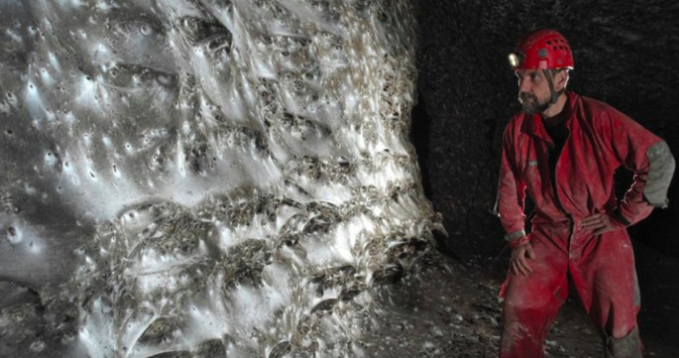
Scientists have discovered an exceptional spider web, likely the largest in the world, thriving in an unsettling subterranean environment. Located in the Sulfur Cave along the border of Albania and Greece, the massive, interconnected web is shared by a colossal colony of over 111,000 spiders.
A Living Silk City Spanning 106 Sq. Meters

Related Post
The sprawling silk network covers an area of approximately 106 square meters, resembling a small, highly populated city. Published in Subterranean Biology, the discovery documents this immense colony living in complete darkness within the cave, which is characterized by high levels of hydrogen sulfide.
Researchers identified two primary species co-existing peacefully within this vast web:
- Approximately 69,000 Tegenaria domestica (a common house spider).
- Approximately 42,000 Prinerigone vagan spiders.
István Urák, a biologist at Sapientia Hungarian University of Transylvania, described the initial encounter with the web as a moment of “awe and gratitude,” highlighting that “Nature still holds many surprises for us.”
A Sulfur-Fueled Ecosystem
What makes this colony truly extraordinary is its self-sustaining ecosystem, which operates completely independent of sunlight. A flow of sulfur feeds specialized bacteria, which in turn produce a white film on the cave walls. Midges, or tiny winged insects, consume this film, and the spiders then feed on the midges—creating an efficient, sulfur-rich food chain.
Reduced Aggression and Unique Adaptation
The sheer size of the colony is matched by the unique behavior of its inhabitants. Both species are typically known for their aggression and reluctance to co-exist peacefully. However, researchers hypothesize that the cave’s total darkness has altered their behavior, leading to reduced aggression and a preference for cooperation over competition.
DNA testing further revealed that the Sulfur Cave spiders possess a distinct microbiome compared to their surface-dwelling relatives, with fewer bacterial species in their guts. This adaptation suggests they have evolved specifically to thrive on their sulfur-rich diet.
The research team believes this unique colony deserves protection, despite the logistical challenges posed by the cave’s location straddling two countries. From a scientific perspective, the presence of over a hundred thousand spiders sharing one home is not a scene from a horror film, but rather a remarkable example of communal life and adaptation to extreme conditions. Source : https://rakyatnesia.com/




Leave a Comment