
Hustler Words – Jenny Shao, a former Harvard-trained physician, has traded her stethoscope for software, launching Robyn, an AI companion designed to offer empathetic support. Inspired by the isolation-induced neurological impacts she observed during the pandemic, Shao left her medical career to create an AI assistant focused on emotional intelligence.
The landscape of AI companionship is complex. While general chatbots like ChatGPT and friendship apps like Replika abound, Robyn aims to carve a unique niche. Shao emphasizes that Robyn is not intended to replace therapists or clinical practitioners.
"As a physician, I have seen things go badly when tech companies try to replace your doctor. Robyn is and won’t ever be a clinical [replacement]. It is equivalent to someone who knows you very well. Usually, their role is to support you. You can think of Robyn as your emotionally intelligent partner," Shao explained.

Related Post

Drawing on her research experience in Nobel Laureate Eric Kandel’s lab, where she studied human memory, Shao has incorporated principles of memory into Robyn’s design. This allows the AI to better understand and remember user interactions, fostering a more personalized experience.
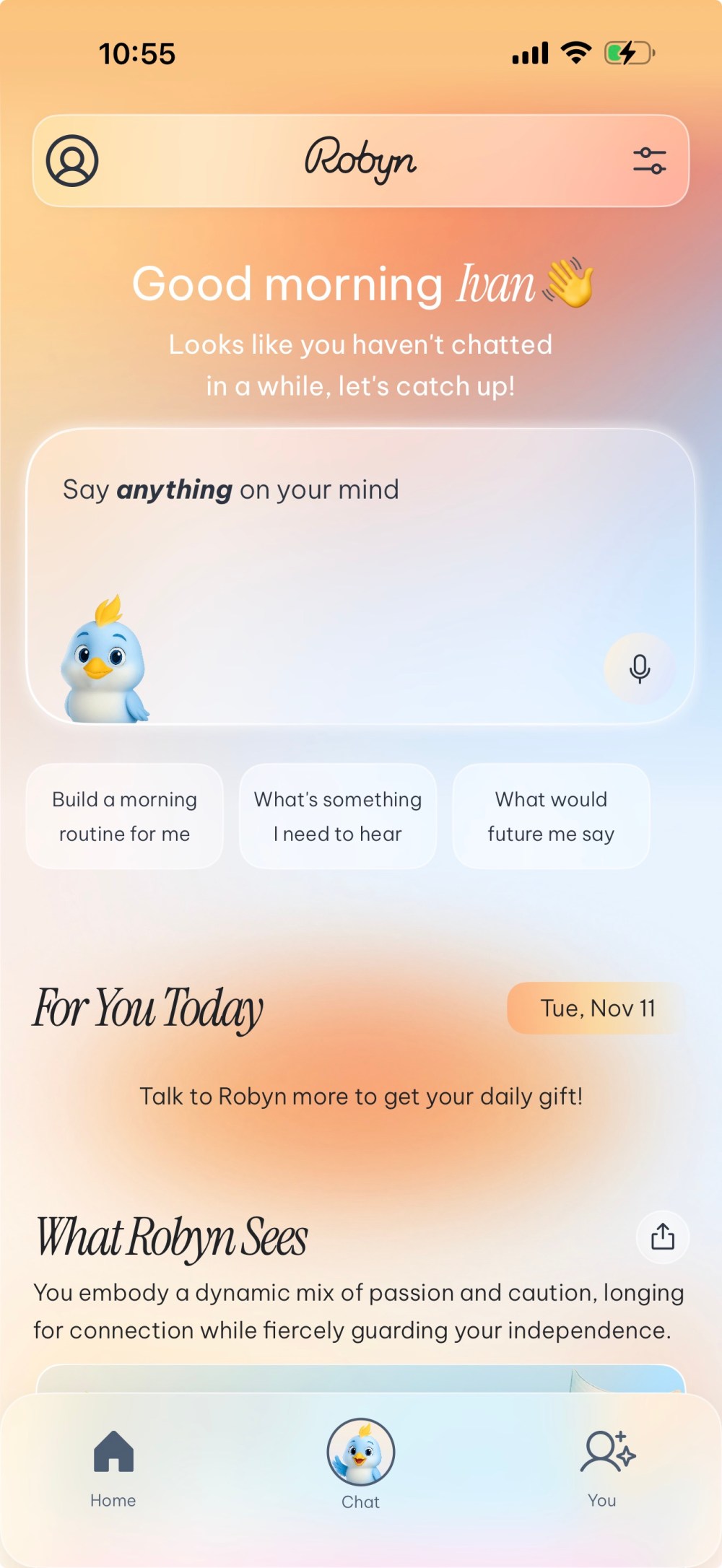
The iOS app features an onboarding process similar to journaling or mental health apps, gathering information about the user’s goals, reactions to challenges, and preferred communication style.
Once onboarded, users can engage in conversations with Robyn on various topics. For example, when prompted to create a morning routine, Robyn asks detailed questions and engages in a conversation about minimizing screen time.
As interactions increase, Robyn provides insights into the user’s patterns, including their emotional fingerprint, attachment style, love language, growth edge, and inner critic. A demo website is also available to analyze X profiles and demonstrate the potential insights Robyn can provide.
Safety is a priority for the company, with guardrails implemented throughout the development process. The app provides crisis line numbers and directs users to the nearest emergency room if self-harm is mentioned. Robyn also avoids certain topics and tasks, such as providing sports scores or counting to 1,000, redirecting users to focus on personal matters.
Robyn has secured $5.5 million in seed funding led by M13, with participation from notable investors, including Google Maps co-founder Lars Rasmussen and Canva investor Bill Tai. The company, which started with three team members, has now grown to ten.
Rasmussen highlighted the app’s emotional memory system and Shao’s mission as key factors in his investment.
"We’re living through a massive disconnection problem. People are surrounded by technology but feel less understood than ever. Robyn tackles that head-on. It’s solving emotional disconnection, helping people reflect, recognize their own patterns, and reconnect with who they are. It’s not about therapy or replacing relationships. It’s about strengthening someone’s capacity to connect – with themselves first, and then with others," he told Hustler Words via email.
A significant challenge for Robyn will be maintaining user safety and preventing users from over-anthropomorphizing the AI.
Latif Parecha, a partner at M13, emphasized the importance of guardrails for AI operating in this sensitive space.
"There needs to be guardrails in place for escalation for situations where people are in real danger. Especially, as AI will be part of our lives just like are family and friends are," Parecha told Hustler Words in an interview.
Robyn, which has been tested with a select group of users, is now launching in the U.S. The subscription-based app costs $19.99 per month or $199 per year.



Leave a Comment