
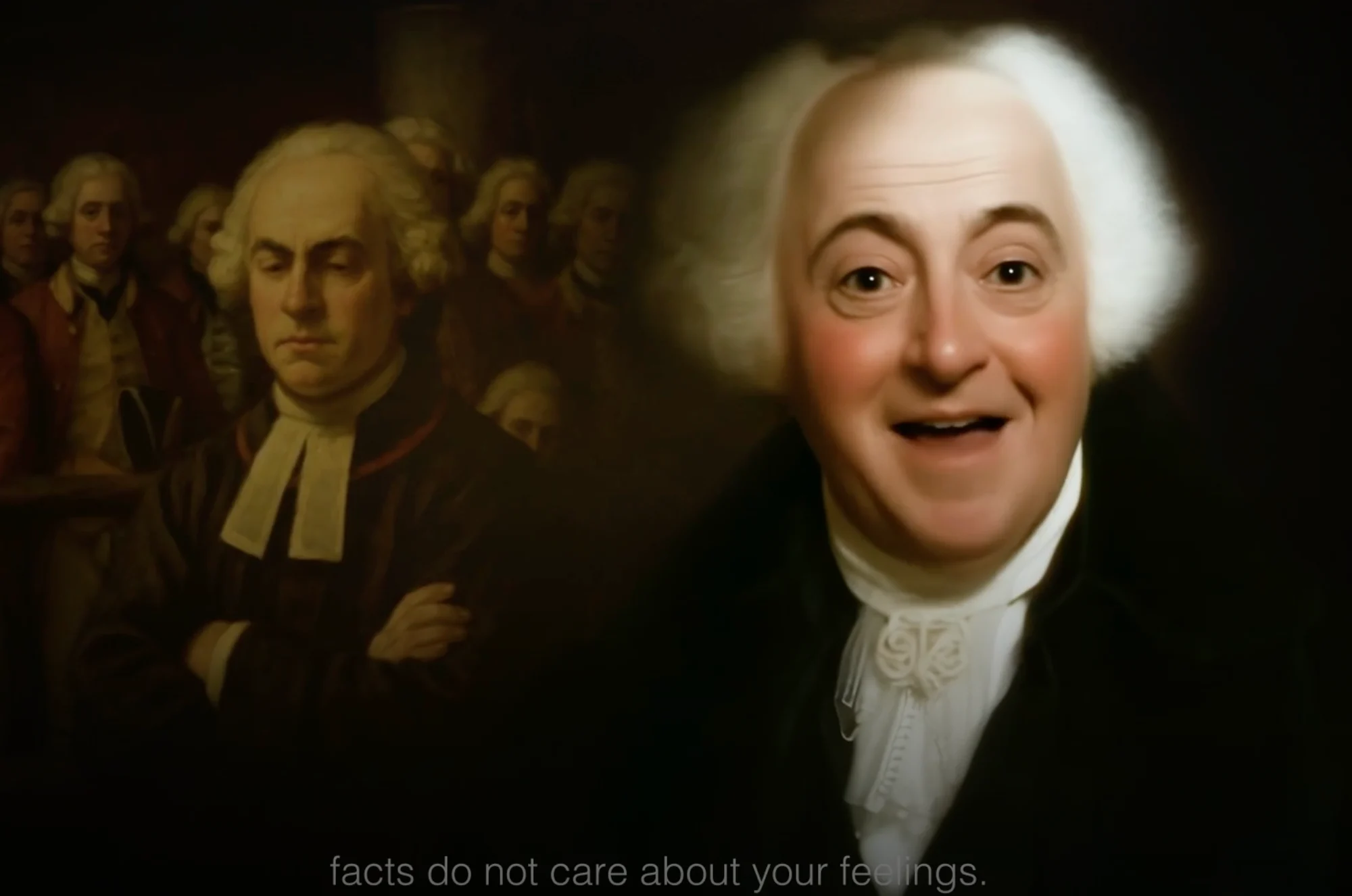
Hustler Words – Google has unveiled a new commercial that boldly reimagines a pivotal moment in American history: the drafting of the Declaration of Independence. Set 250 years after its original signing, the advertisement poses a fascinating question: what if the Founding Fathers had the advanced collaborative capabilities of Google Workspace and artificial intelligence at their disposal?
The ad, cleverly tagged "Group project, but make it 1776," transports viewers to a digital rendition of colonial America. We see a glimpse of Thomas Jefferson in the throes of composition, only to be interrupted by a familiar text notification from Benjamin Franklin. This initiates a highly digitized collaborative process, showcasing Google’s suite of tools. Edits to the foundational document are proposed and reviewed within Google Docs, a crucial meeting is scheduled via Google Calendar, and the historic discussion unfolds remotely on Google Meet – humorously, with every participant’s camera seemingly off. The final seal of approval is given through e-signatures, culminating in a celebratory display of fireworks.
Naturally, as a contemporary tech advertisement, artificial intelligence plays a significant, albeit subtle, role. The fictionalized historical figures leverage Google’s "help me visualize" AI feature to experiment with various animal designs for the national seal. Gemini, Google’s advanced chatbot, diligently records meeting notes, ensuring no historical detail is lost. Furthermore, the founders consult Gemini for strategic advice before politely declining King George III’s digital request for document access. This integration of AI is notably more restrained than in some of Google’s prior campaigns, such as the controversial ad where Gemini assisted a father in writing a fan letter. The commercial deliberately avoids suggesting that AI could improve the actual text of the Declaration, focusing instead on its utility as a collaborative and assistive tool. Intriguingly, some observers suggest the video footage itself possesses the distinct, almost ethereal quality often associated with AI-generated visuals.

Related Post

The commercial’s reception has been a mixed bag, reflecting the ongoing societal debate surrounding AI’s place in creative and historical narratives. While comments across YouTube and Instagram largely lean positive, the discourse on platforms like Bluesky has been considerably more critical. Posters there have labeled the advertisement "cringey" and "stunningly tone deaf," with the AI angle drawing the most significant fire. Yet, paradoxically, many of these critics, including historian Angus Johnston, pointed out "how little of this is actually AI."
Johnston further articulated his skepticism, stating, "Even in a corny fantasy joke, it’s impossible to make the case that AI is a useful tool for political organizing, writing, or human collaboration." This sentiment underscores a broader concern: while AI offers powerful assistive capabilities, its role in genuinely human-centric endeavors, particularly those requiring nuanced political thought and deep collaborative writing, remains a contentious and often unconvincing proposition for many. The Google ad, despite its lighthearted approach, inadvertently highlights this enduring tension between technological advancement and the irreplaceable essence of human ingenuity.




Leave a Comment