
Hustler Words – India’s burgeoning artificial intelligence landscape is poised at a critical juncture, as technology behemoths shift their focus from aggressive user acquisition to sustainable revenue generation. Following a period of widespread free promotions, companies are now looking to convert the world’s fourth-largest economy, a hotbed for AI adoption, into a significant source of paid subscriptions.
The subcontinent solidified its position as the global leader in generative AI application downloads in 2025, according to market intelligence firm Sensor Tower. Surpassing the United States, India witnessed an astounding 207% year-over-year surge in installs, underscoring its rapid embrace of AI technologies.
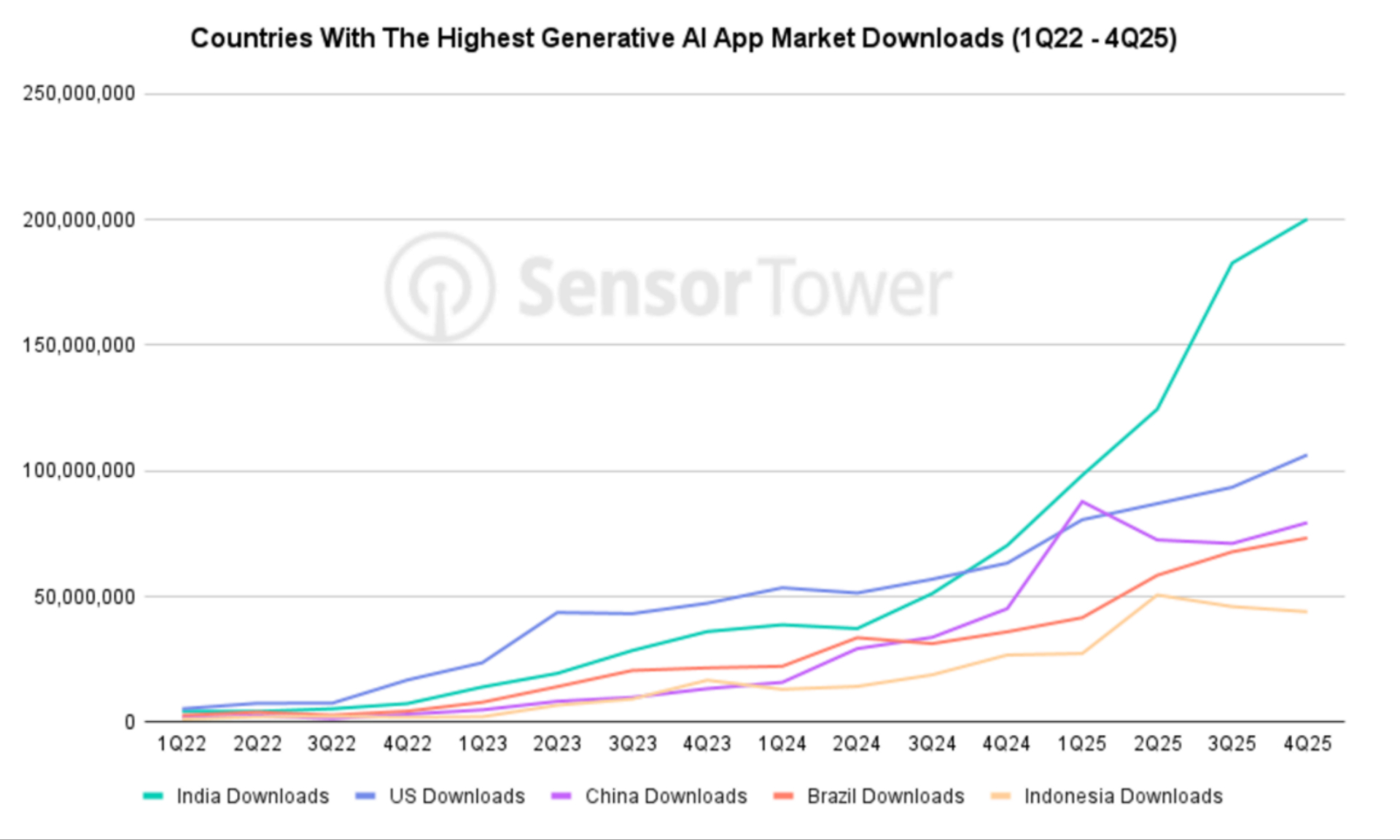
Giants such as OpenAI, Google, and Perplexity strategically deployed extended free premium offers to catalyze user growth within India’s notoriously price-sensitive market. These leading AI innovators have also actively supported India’s ambition to become a global AI powerhouse. A high-profile AI summit in New Delhi recently drew luminaries like OpenAI’s Sam Altman, Anthropic’s Dario Amodei, and Alphabet CEO Sundar Pichai, signaling India’s escalating influence in the worldwide AI arena.

Related Post

However, the era of widespread free access is now drawing to a close. Perplexity concluded its bundled Pro offering with Indian telecom giant Airtel in January, while OpenAI’s complimentary ChatGPT Go access in India is no longer available. This transition sets the stage for a crucial assessment of how many of these newly acquired users will ultimately convert into paying subscribers.
Despite the impressive download figures, India currently contributes a disproportionately small share to the global AI app revenue. Sensor Tower data, shared with Hustler Words, reveals that India accounts for approximately 1% of in-app purchases, even as it drives roughly 20% of global GenAI app downloads. This stark disparity highlights the formidable monetization challenge facing companies in one of the industry’s most rapidly expanding markets.
Generative AI app adoption in India experienced a sharp acceleration throughout 2025, with downloads peaking in September and October at year-over-year growth rates of approximately 320% and 260%, respectively. Yet, this surge in usage did not fully translate into revenue gains. In November and December 2025, AI app in-app purchase revenue in India declined by 22% and 18% month-over-month, respectively. ChatGPT’s revenue saw an even steeper drop—down 33% and 32% over the same period—following the November launch of its free sub-$5 ChatGPT Go access, illustrating the immediate impact of aggressive promotional strategies.
ChatGPT maintains a commanding lead, capturing over 60% of GenAI in-app revenue in India, meaning any shifts in its pricing strategy can significantly influence the overall market performance.
Beyond promotional pushes, Sensor Tower attributes last year’s surge in GenAI app adoption in India to a confluence of factors. These include the introduction of new platforms like DeepSeek, Grok, and Meta AI, alongside significant upgrades to established chatbots such as ChatGPT, Gemini, Claude, and Perplexity. The viral spread of AI-generated content also played a pivotal role, with content creation and editing tools comprising seven of the top 20 most downloaded GenAI apps in India in 2025.
The explosion in user numbers has been equally pronounced. In 2025, India accounted for approximately 19% of the global user base for leading AI assistant applications, surpassing the U.S. at 10%, according to Sensor Tower. ChatGPT continues to dominate the Indian market in terms of monthly active users, although competitors like Google’s Gemini and Perplexity have also experienced rapid growth following their promotional campaigns. Earlier Sensor Tower data identified ChatGPT as the most downloaded GenAI app in India and globally in 2025, with OpenAI’s CEO recently confirming the chatbot now boasts over 100 million weekly active users in India.
Sneha Pandey, an insights analyst at Sensor Tower, explained that the aggressive promotional push in India reflects a broader strategy by AI firms to mitigate pricing friction in a highly value-conscious market. The underlying gamble is that early user adoption and deep engagement will foster stronger long-term retention once the free access periods conclude.
India’s immense digital footprint makes it an irresistible prospect. With over a billion internet users and approximately 700 million smartphone owners, the country represents one of the largest potential markets for AI services globally and a crucial battleground for user growth.
Nonetheless, user engagement in India still lags behind more mature markets. In 2025, users of leading AI chatbot apps in the U.S. spent about 21% more time per week on these applications than their Indian counterparts and logged 17% more sessions on average, as per Sensor Tower data.
"AI in-app revenues will likely see meaningful but gradual improvement as users become more deeply integrated into these platforms, making sustained engagement paramount," Pandey informed Hustler Words. She further noted that pricing pressure in India is expected to remain high due to the country’s youthful and value-conscious user base. This necessitates strategies such as lower-cost tiers, telecom bundles, and micro-transaction models for effective long-term retention.
Entering 2026, ChatGPT remained the undisputed market leader in India, recording 180 million monthly active users in January, according to Sensor Tower. Google’s Gemini followed with 118 million, then Perplexity with 19 million, and Meta AI with 12 million. These figures underscore both the monumental scale of India’s AI opportunity and the escalating challenge for companies to translate rapid user adoption into consistent, sustainable revenue streams. Google, OpenAI, and Perplexity did not respond to requests for comments.




Leave a Comment