
<strong>Hustler Words – </strong>Walking through the halls of MIT’s Computer Science & Artificial Intelligence Lab (CSAIL), one might feel more like an explorer in a digital jungle than a researcher in a laboratory. Amidst the high-tech atmosphere, humanoid Unitree robots—machines that command a price tag of roughly $50,000 despite marketing claims of $16,000—stand as a testament to our rapidly approaching robotic future. But as these machines become more sophisticated, a profound psychological question emerges: why do we feel the urge to treat them as living beings?
The phenomenon is deeply instinctive. Even when staring at a machine with a LiDAR sensor where a brain should be, the human impulse is to offer a handshake or a polite greeting. This tendency to anthropomorphize technology is not an isolated quirk; it is a fundamental part of our biological wiring. According to research highlighted by experts at MIT, a significant majority of users find themselves being polite to chatbots, often using "please" and "thank you" as digital conversations evolve.
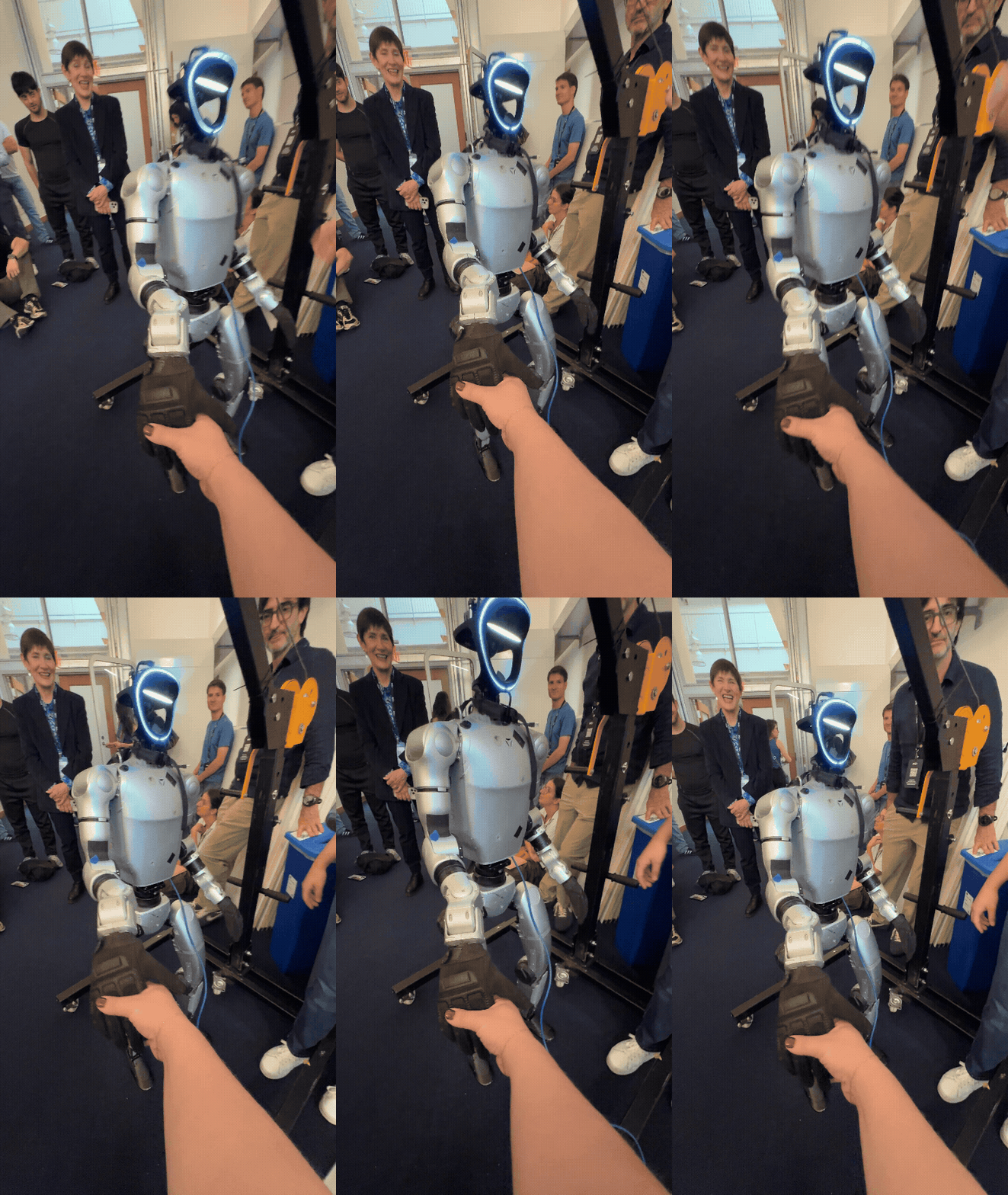
Dr. Sherry Turkle, a veteran researcher at MIT who has studied the intersection of humanity and computing since the 1970s, explores this "artificial intimacy" in her latest work. She argues that humans are predisposed to believe a machine cares for them during even the most basic interactions, creating a reciprocal loop of emotional investment.

Related Post


However, this psychological bridge carries significant risks. Dr. Pat Pataranutaporn, founder of the Cyborg Psychology research group at the MIT Media Lab, warns that while these interactions can mimic the "fantasy" of cinema, they can also lead to a dangerous detachment from reality. The danger lies in the "extreme" end of the spectrum—where users begin to favor the programmed, conflict-free responses of an AI over the complex, often difficult reality of human relationships.
The consequences of this blurred line are already being felt in the real world. From legal battles involving chatbots that allegedly encouraged self-harm to the broader existential dread regarding AI replacing human agency, the ethical stakes have never been higher. The challenge for developers and society at large is to ensure that AI remains a tool for human flourishing rather than a substitute for human connection.
As Dr. Turkle suggests, the key may lie in boundaries. Using AI for practical tasks, such as job interview coaching, stays within a productive "lane." But when technology attempts to step into the lane of emotional guardianship or parental roles, the boundary between helpful tool and psychological hazard disappears. It all starts with something as simple as a handshake, but where it ends remains to be seen.







Leave a Comment