
Hustler Words – The landscape of consumer artificial intelligence is witnessing a sudden, vibrant resurgence. From Meta’s surprisingly popular "Muse" assistant and its charming mascot Jolly, to OpenAI’s newly unveiled "Dots," the industry is pivoting back toward friendly, character-driven personal agents. Even the startup Instinct has skyrocketed to a $10 billion valuation by perfecting "agentic" tasks—the ability to autonomously book flights, secure dinner reservations, or manage pesky subscription cancellations. To a casual observer, it looks like the golden age of AI has arrived, mirroring the explosive excitement of ChatGPT’s debut in 2022.
However, beneath this veneer of consumer excitement lies a harsh financial reality that has kept many leading AI labs at arm’s length. The issue isn’t the capability of the technology; it is the "ugly economics" of the business model. While the tech is getting smarter, the willingness of the average person to open their wallet is hitting a stubborn ceiling. This fiscal friction has forced the industry’s heavyweights to pivot toward the "Anthropic model," prioritizing lucrative enterprise contracts over the unpredictable whims of the general public.
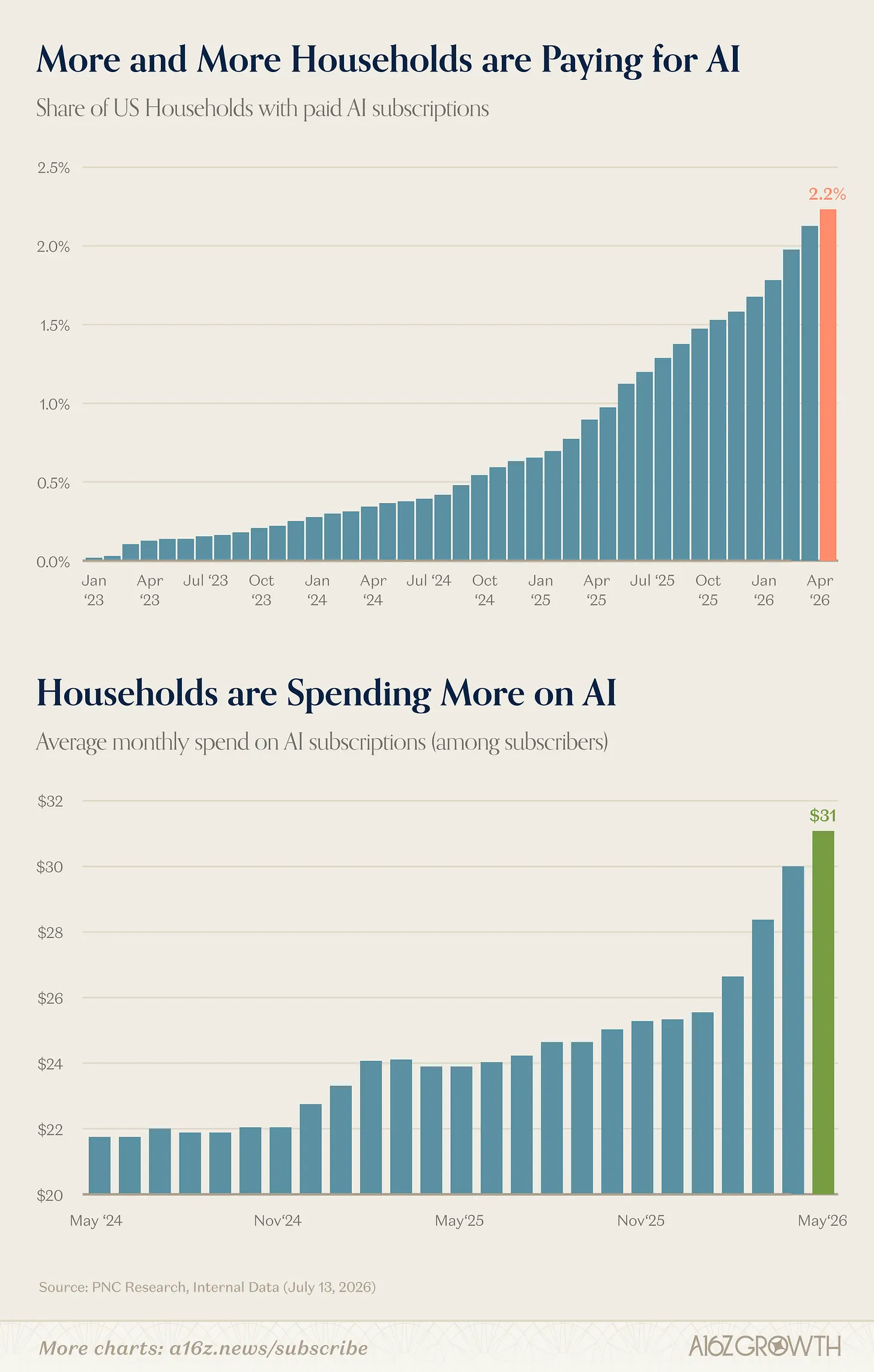
Data from Andreessen Horowitz and PNC research highlights a sobering trend: consumer adoption is growing, but at a painfully linear pace. As of mid-2024, only about 2.2% of consumers were paying for AI services, with an average monthly spend of roughly $31. While some analysts view this as an early-stage opportunity, the math remains daunting. Even if an AI service achieved the massive scale of Netflix, a $34 monthly fee would generate roughly $11 billion in annual revenue—a figure that wouldn’t even cover a third of OpenAI’s massive operating costs.

Related Post

The fundamental problem is that AI is exponentially more expensive to run than the social media or cloud services that preceded it. Unlike traditional software, every single query costs a significant amount in compute power. This creates a high "break-even" bar that is difficult to clear through individual subscriptions alone.
Smart players are already finding workarounds. OpenAI has successfully transitioned much of its focus toward the enterprise sector, where bookings have reportedly doubled recently. By selling high-end tools to businesses at a premium, they can subsidize the consumer experience. Meanwhile, Meta can leverage its unparalleled advertising data to monetize Muse, and Instinct is exploring a transaction-based model, taking a commission on purchases made through its agent.
Ultimately, the current boom in "cute" and "helpful" AI assistants serves as a reminder: while the technology is ready to run our lives, the business models are still struggling to run a profitable company. Without a bridge to enterprise revenue, the consumer AI dream may remain a beautiful, but expensive, illusion.




Leave a Comment