
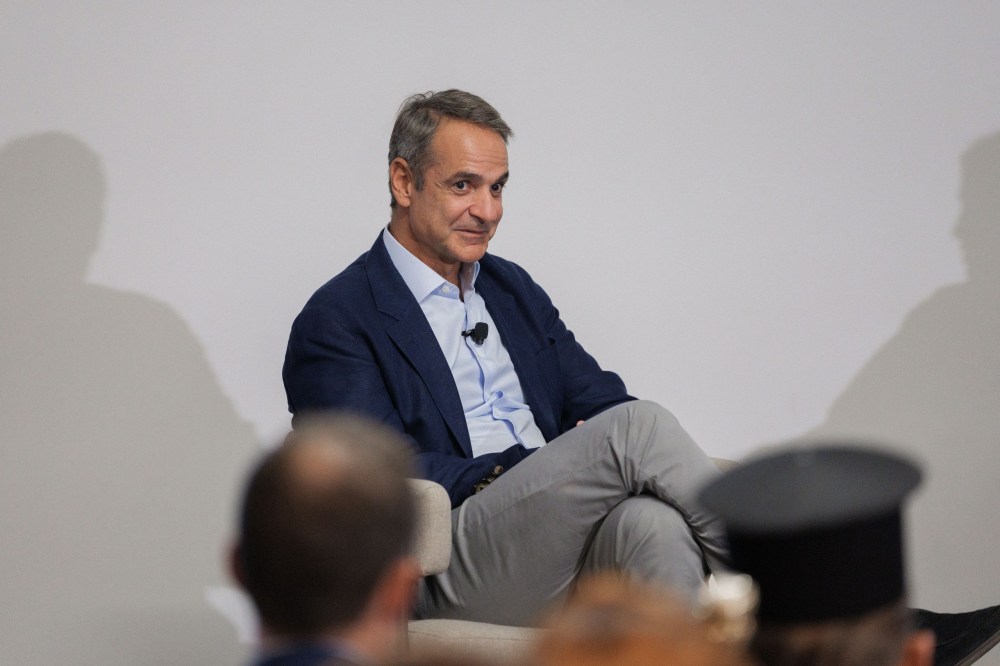
Hustler Words – In an unusual display of transparency for a head of state on a trade mission, Greek Prime Minister Kyriakos Mitsotakis recently addressed a gathering of tech luminaries in San Francisco, openly admitting his lack of definitive answers regarding the profound challenges posed by artificial intelligence. His visit, part fact-finding and part bridge-building, underscored Greece’s economic resurgence and its ambitious push to position itself as a burgeoning tech hub, as reported by Hustler Words.
Mitsotakis, an alumnus of Stanford, framed his Bay Area trip as a "homecoming," emphasizing Greece’s remarkable economic turnaround. The nation is rapidly reducing its debt and, surprisingly, now secures loans at more favorable rates than the United States – a stark contrast to its debt crisis era when bond yields soared above 40%. This financial stability is paving the way for Greece to regain developed market status from MSCI next year, signaling its return to mainstream economic standing.
A significant portion of Greece’s €36 billion allocation from the EU’s post-COVID recovery fund has been strategically invested in digital infrastructure. This includes the development of an online portal streamlining government services for citizens and a state-of-the-art supercomputer, built in collaboration with Hewlett Packard Enterprise in Lavrio, poised to power AI and scientific research within months. Furthermore, the government has enacted policy reforms to attract tech companies, such as adjusting stock option taxation, loosening labor laws, and offering substantial tax incentives for returning Greek professionals. The Prime Minister also highlighted efforts to enhance visa programs, though he acknowledged ongoing work on processing efficiency.

Related Post

Mitsotakis also noted a cultural shift within Greece’s public universities, which he described as moving away from a historically "radical leftist approach" that viewed corporations with skepticism, now fostering a vibrant startup ecosystem. His broader vision involves reclaiming the talent lost during the debt crisis, suggesting that with tightening U.S. work visa policies, Greece presents an attractive alternative for founders seeking skilled labor.
However, the conversation took a distinctly introspective turn when addressing AI’s societal implications. Mitsotakis was remarkably frank about the evolving nature of these challenges. He cited Greece’s upcoming ban on social media for children under 15, effective January, yet conceded that such measures might already be "fighting yesterday’s battle" given the pervasive and potentially addictive nature of AI chatbots. He pondered the implications of children growing up with "digital companions or boyfriends or girlfriends."
Regarding AI in education, the Prime Minister acknowledged the potential of personalized AI tutors and a pilot program with OpenAI to reduce teachers’ administrative burdens. Still, he cautioned against AI replacing "the hard work of learning the basic skills," noting students’ increasing reliance on chatbots for homework and warning against "complacency."
On the infrastructure front, Greece stands out. Despite global opposition to data centers due to their significant electricity and water demands, Mitsotakis stated that Greece has encountered "no significant reaction." He pointed to Microsoft’s data center cluster near Athens and AWS’s plans for the country’s largest data center in a former coal region, where these projects are actively welcomed.
Mitsotakis refrained from offering simplistic solutions for the future, particularly concerning job displacement. He starkly admitted that it "is something which is going to happen, and no government and no society is prepared for the speed with which it will happen." He aligned with calls from frontier AI lab leaders for a slowdown in development, emphasizing the need to heed their warnings when they express uncertainty about the models they are creating.
While anticipating some form of "smart regulation," likely shaped by the U.S., Mitsotakis expressed Greece’s willingness to host these crucial global conversations. He eloquently framed the advent of AI as humanity creating "a form of intelligence that is very quickly exceeding the capacity of the most advanced organ that evolution has ever created," prompting fundamental questions about human identity. He envisioned Greece, with its rich philosophical heritage, as an ideal venue to bring together technologists, social scientists, philosophers, and historians to grapple with these profound issues.
Indeed, in the birthplace of Socrates, where fundamental questions about life and society were once debated in the agora, perhaps the complex dilemmas posed by Silicon Valley’s latest innovations might find their resolution.




Leave a Comment