
Hustler Words – Following Amazon CEO Andy Jassy’s recent announcement of a monumental $50 billion investment by AWS into OpenAI, a select group, including a journalist from Hustler Words, was granted an exclusive glimpse into the clandestine heart of this strategic alliance: Amazon’s advanced chip development facility. This rare tour offered a firsthand look at the innovation driving the deal, particularly the AWS Trainium chip, which is rapidly gaining traction among AI industry titans like Anthropic, OpenAI, and even Apple, signaling a potential paradigm shift in the competitive AI hardware landscape.
Industry observers are keenly watching the evolution of Amazon’s custom silicon, developed within this cutting-edge lab. Its implications for significantly reducing the cost of AI inference – the process of running AI models to generate responses – are profound, threatening to carve a substantial dent in Nvidia’s near-monopolistic grip on the high-performance AI accelerator market.
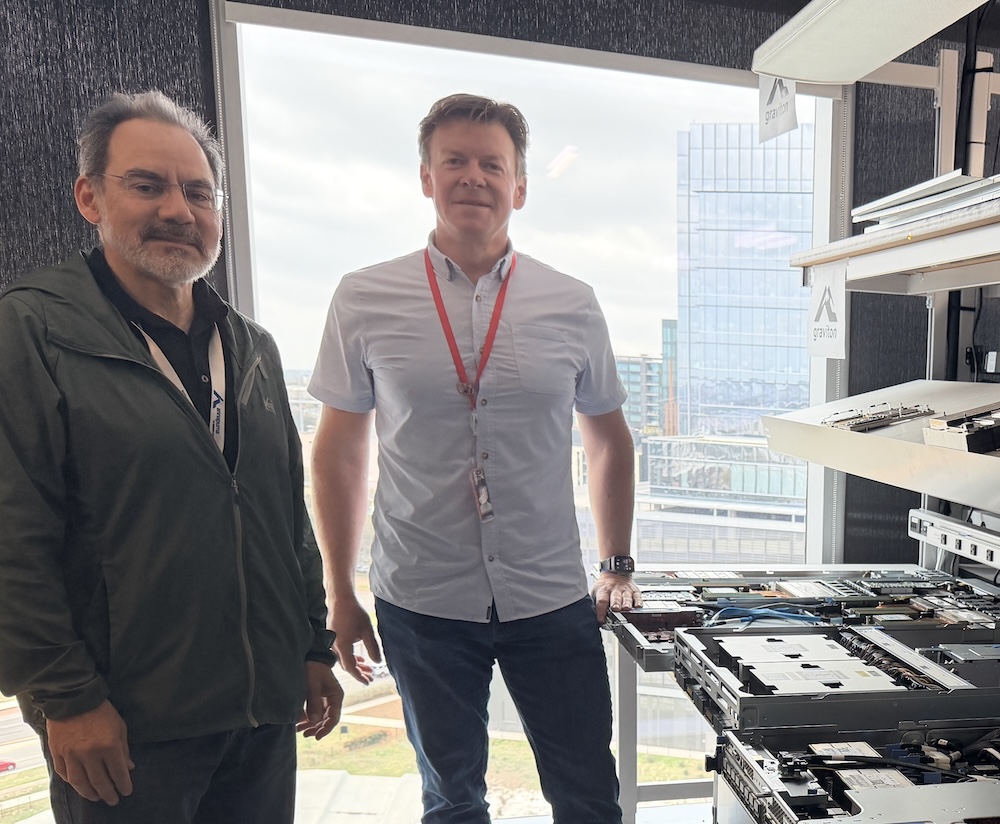
The exclusive tour was led by the lab’s director, Kristopher King, and director of engineering, Mark Carroll, alongside PR representative Doron Aronson. Their insights painted a vivid picture of Amazon’s decade-long journey in custom chip design, rooted in its 2015 acquisition of Israeli firm Annapurna Labs, whose logo still adorns the Austin facility.

Related Post

Powering AI’s Elite: Anthropic and OpenAI
AWS has been a foundational cloud platform for Anthropic since its inception, a partnership so robust it has endured Anthropic’s subsequent collaboration with Microsoft. Now, Amazon’s deepening ties with OpenAI further underscore Trainium’s critical role. The OpenAI agreement positions AWS as the exclusive provider for OpenAI’s forthcoming AI agent builder, Frontier, a product poised to become a cornerstone of OpenAI’s business if AI agents achieve widespread adoption. This exclusivity, however, has reportedly raised eyebrows at Microsoft, which may view it as conflicting with its own agreements with OpenAI.
A key factor in AWS’s appeal to OpenAI is its commitment to supply 2 gigawatts of Trainium computing capacity. This is a staggering pledge, especially considering that both Anthropic and Amazon’s own Bedrock service are already consuming Trainium chips at an unprecedented rate, challenging Amazon’s production capabilities. With 1.4 million Trainium chips deployed across three generations, over a million of the Trainium2 chips alone power Anthropic’s Claude, demonstrating the platform’s scale and demand.
Initially optimized for faster, more cost-effective model training, Trainium has evolved to excel in inference, addressing what is now considered the industry’s most significant performance bottleneck. Trainium2, for instance, handles the majority of inference traffic on Amazon’s Bedrock service, which empowers enterprise clients to build AI applications utilizing diverse models. "Our customer base is just expanding as fast as we can get capacity out there," King noted, envisioning Bedrock potentially rivaling the scale of AWS’s colossal EC2 compute cloud service.
Trainium vs. Nvidia: A Cost-Performance Showdown
Beyond merely offering an alternative to Nvidia’s often backlogged and expensive GPUs, Amazon asserts that its Trainium chips, particularly when deployed on its specialized Trn3 UltraServers, can achieve comparable performance at up to 50% lower operational costs than traditional cloud servers.
The December release of Trainium3, coupled with new Neuron switches, represents a transformative leap. Carroll highlighted that these switches enable a mesh configuration where every Trainium3 chip can communicate directly with every other chip, drastically reducing latency. "That’s why Trainium3 is breaking all kinds of records," he stated, particularly in terms of "price per power" – a crucial metric when processing trillions of tokens daily.
Amazon’s chip team garnered rare public praise from Apple in 2024, with the iPhone maker’s AI director acknowledging the team’s Graviton (an ARM-based server CPU) and Inferentia (a dedicated inference chip), while also nodding to the then-nascent Trainium. This strategy aligns with Amazon’s classic playbook: identify market demand, then build a cost-competitive in-house alternative.
Historically, switching costs have deterred developers from migrating away from Nvidia’s CUDA ecosystem. However, the AWS chip team proudly announced Trainium’s support for PyTorch, a widely adopted open-source framework for AI model development, including those found on Hugging Face. Carroll claims the transition requires "basically a one-line change, and then recompile, and then run on Trainium," significantly easing the migration burden and directly challenging Nvidia’s market dominance. AWS has also recently partnered with Cerebras Systems to integrate their inference chips with Trainium servers, promising enhanced, low-latency AI performance.
Amazon’s ambition extends beyond the chips themselves. The team designs the entire server infrastructure, including the "Nitro" hardware-software combo for virtualization, state-of-the-art liquid cooling technology, and the server sleds that house these components. This holistic approach ensures optimized cost and performance across the entire stack.
Inside the "Bring-Up" Lab: Where the Magic Happens
Located in Austin’s upscale "The Domain" district, the Annapurna Labs facility exudes a typical tech corporate ambiance, but its true gem is the "bring-up" lab. This noisy, industrial space, roughly the size of two large conference rooms, offers panoramic city views and serves as the crucible where new chips are first brought to life. While the 3-nanometer Trainium3 chips are manufactured by TSMC (with other chips by Marvell), this lab is where their functionality is verified.
"A silicon bring-up is when you get the chip for the first time, and it’s like a big overnight party," King explained. After 18 months of development, the chip is activated to confirm it performs as designed – a process rarely without its challenges. For Trainium3, an initial air-cooled prototype encountered a dimensional mismatch with its heat sink. Undeterred, the team "immediately got a grinder and just started grinding off the metal" in a conference room to avoid disturbing the celebratory atmosphere. This improvisational problem-solving, King emphasized, is the essence of a silicon bring-up.
The lab is equipped with specialized tools, including a welding station where hardware lab engineer Isaac Guevara demonstrated the intricate process of welding tiny integrated circuit components under a microscope – a feat of precision that even senior leaders like Carroll openly admitted they couldn’t replicate. Signal engineer Arvind Srinivasan showcased equipment used to meticulously test each component on a chip.
The Sleds: Unsung Heroes of AI Compute
A prominent feature of the lab is a display showcasing each generation of "sleds" – the custom-designed trays that house Trainium AI chips, Graviton CPUs, and supporting boards. These sleds, when stacked with custom-designed networking components, form the powerful systems underpinning Anthropic Claude’s success and were prominently featured at the AWS re:Invent conference.
While the OpenAI deal was a significant backdrop, the engineers on the tour, currently focused on designing Trainium4, revealed their day-to-day work has primarily revolved around Anthropic’s and Amazon’s internal needs. Nonetheless, a subtle pride in the OpenAI collaboration was evident, with a wall monitor in the main office displaying a quote about OpenAI’s adoption of Trainium.
Beyond the lab, the team operates a private data center for quality assurance and testing, distinct from AWS customer data centers. This facility, a short drive away, is characterized by mandatory earplugs due to the deafening cooling systems and the acrid scent of heated metal. Here, rows of Trn3 UltraServers integrate Graviton CPUs, liquid-cooled Trainium3 chips, and Amazon Nitro, all computing away. The closed-loop liquid cooling system not only enhances performance but also contributes to environmental sustainability.
The scrutiny on this team has intensified, with Amazon CEO Andy Jassy publicly championing their innovations. In December, he declared Trainium a multi-billion-dollar business for AWS and highlighted it as a key technology in the OpenAI agreement. This executive attention fuels the team’s commitment, driving them to work around the clock during "bring-up" events to ensure rapid mass production. "It’s very important that we get as fast as possible to prove that it’s actually going to work," Carroll affirmed. "So far, we’ve been doing really well."


Leave a Comment