
Hustler Words – India’s vibrant startup ecosystem concluded 2025 with an impressive nearly $11 billion in capital infusion, yet the narrative was one of heightened investor scrutiny and a strategic recalibration. This discerning approach marks a significant divergence from the concentrated, AI-driven capital surges witnessed in the United States, positioning India as a unique player in the global innovation landscape.
The shift towards selectivity was starkly evident in the deal-making arena. According to data compiled by Tracxn, the sheer volume of startup funding rounds contracted by almost 39% year-over-year, settling at 1,518 transactions. While the total capital deployed experienced a more moderate dip of just over 17%, reaching $10.5 billion, the underlying dynamics revealed a market maturing under pressure.
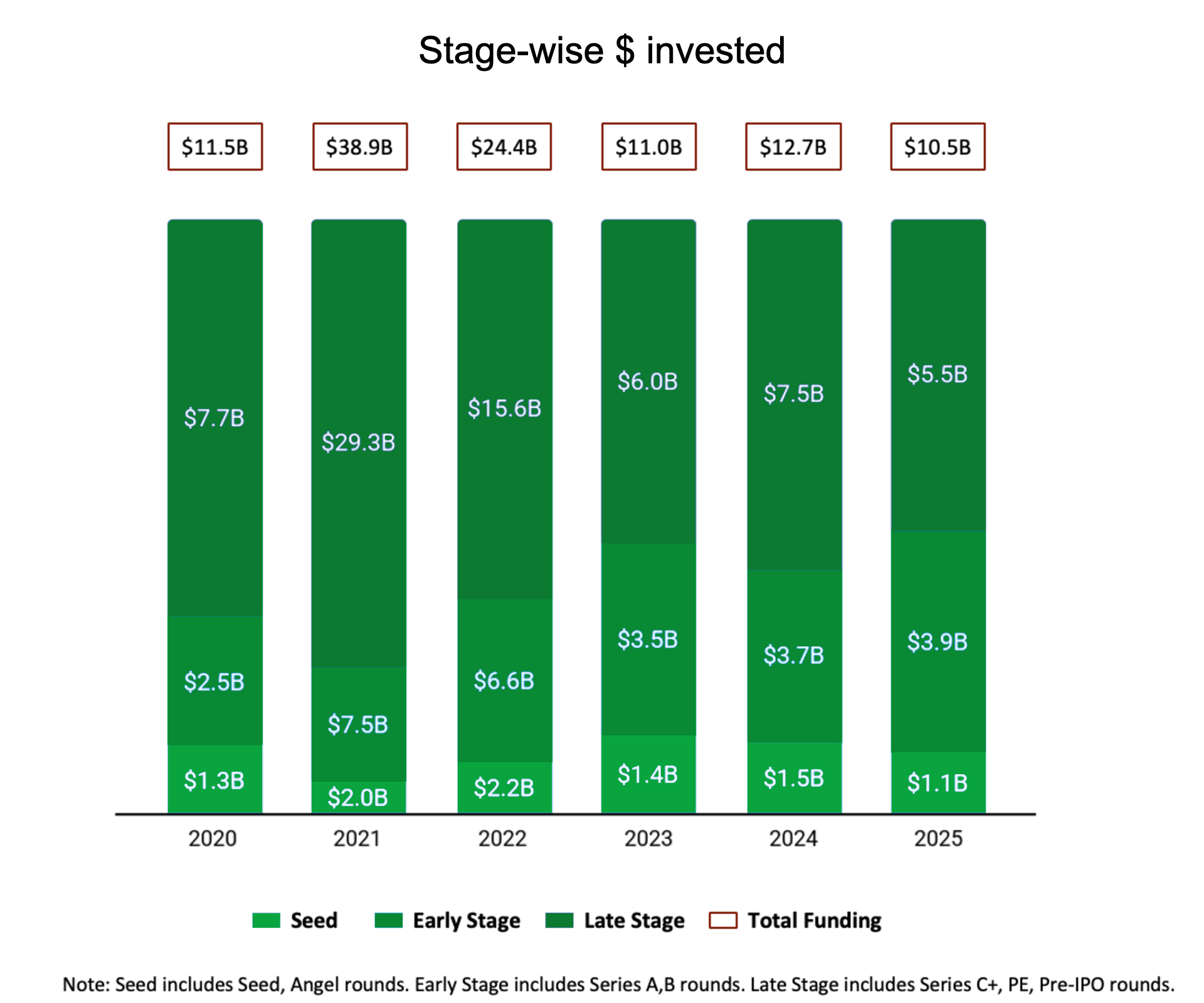
This pullback wasn’t uniform across all investment stages. Seed-stage funding, often a barometer for experimental ventures, saw a sharp decline of 30% to $1.1 billion as investors became more risk-averse. Late-stage investments also cooled, falling 26% to $5.5 billion amidst rigorous evaluations of scalability, profitability, and potential exit strategies. In contrast, early-stage funding demonstrated remarkable resilience, climbing 7% year-over-year to $3.9 billion. Neha Singh, co-founder of Tracxn, commented on this trend, noting, "The capital deployment focus has increased towards early-stage startups." She emphasized a growing confidence in founders who can articulate a strong product-market fit, demonstrate clear revenue visibility, and exhibit sound unit economics within a tighter funding environment.



The AI Paradox: India’s Measured Approach
Nowhere was India’s distinctive investment philosophy more apparent than in the realm of Artificial Intelligence. Indian AI startups attracted just over $643 million across 100 deals in 2025, a modest 4.1% increase from the previous year, as per Tracxn data shared with Hustler Words. This capital was predominantly channeled into early and early-growth stages, with early-stage AI funding accounting for $273.3 million and late-stage rounds securing $260 million. This preference underscores an investor appetite for application-led AI solutions over the capital-intensive development of foundational models.
This stands in sharp contrast to the U.S., where AI funding in 2025 skyrocketed past $121 billion across 765 rounds, marking a staggering 141% jump from 2024, overwhelmingly dominated by late-stage deals. Prayank Swaroop, a partner at Accel, highlighted India’s current limitations, stating, "We don’t yet have an AI-first company in India, which is $40-$50 million of revenue, if not $100 million, in a year’s time frame, and that is globally happening." He further elaborated to Hustler Words that India currently lacks the foundational model companies and requires time to cultivate the necessary research depth, talent pipeline, and patient capital to compete at that fundamental layer. Consequently, application-led AI and adjacent deep-tech areas represent a more pragmatic and immediate focus for the nation.
Beyond AI: Strategic Sector Diversification
This pragmatic outlook has significantly influenced where investors are placing their long-term bets beyond core AI. Venture capital is increasingly gravitating towards manufacturing and deep-tech sectors. These areas present India with distinct advantages, including less global capital competition, favorable talent pools, competitive cost structures, and expansive customer access. While AI commands substantial investor attention, capital distribution in India remains more diversified than in the U.S., with considerable funding still flowing into consumer, manufacturing, fintech, and deep-tech startups. Swaroop specifically identified advanced manufacturing as a burgeoning long-term opportunity, noting a near tenfold increase in such startups over the past four to five years, describing it as a clear "right to win" for India given the reduced global competition.
Rahul Taneja, a partner at Lightspeed, observed that while AI startups constituted roughly 30-40% of deals in India in 2025, there was a parallel surge in consumer-facing companies. This trend is fueled by evolving urban consumer behaviors demanding faster, more on-demand services – from quick commerce to household solutions. These categories capitalize on India’s inherent scale and density, rather than the capital-intensive models often seen in Silicon Valley.
India vs. The U.S.: A Tale of Two Ecosystems
Data from PitchBook illustrates a stark divergence in capital deployment between India and the U.S. in the fourth quarter of 2025. U.S. venture funding surged to $89.4 billion in that quarter alone, compared to approximately $4.2 billion raised by Indian startups over the same period. However, Taneja of Lightspeed cautioned against direct comparisons, emphasizing that differences in population density, labor costs, and consumer behavior fundamentally shape which business models can achieve scale. Categories like quick commerce and on-demand services have found significantly greater traction in India, reflecting local economic realities rather than any perceived lack of ambition from founders or investors. Lightspeed’s recent $9 billion capital raise, with a strong AI focus, is primarily geared towards the U.S. market’s distinct maturity cycle, while its India arm remains committed to backing consumer startups and selectively exploring AI opportunities tailored to local demand.
Nuances in India’s Startup Landscape
The tightening investment climate also impacted women-led startups. Capital invested in women-founded tech ventures remained relatively stable at around $1 billion in 2025, a modest 3% dip from the previous year, according to Tracxn’s report. However, beneath this headline figure lay a more pronounced contraction: the number of funding rounds for women-founded startups fell by 40%, and first-time funded counterparts saw a 36% decline.
Overall investor participation narrowed sharply due to increased selectivity. Approximately 3,170 investors engaged in funding rounds in India this year, a significant 53% drop from roughly 6,800 a year prior, as per Tracxn data shared with Hustler Words. Notably, India-based investors accounted for nearly half of this activity, with around 1,500 domestic funds and angels participating, signaling a more prominent role for local capital as global investors exercised caution. Activity also became more concentrated among a smaller cohort of repeat backers, with Inflection Point Ventures leading the charge with 36 funding rounds, followed by Accel with 34.
Government as a Catalyst for Growth
The Indian government’s involvement in the startup ecosystem became notably more pronounced in 2025. New Delhi launched a $1.15 billion Fund of Funds in January to expand capital access for startups. This was complemented by a ₹1 trillion ($12 billion) Research, Development, and Innovation scheme targeting critical areas such as energy transition, quantum computing, robotics, space technology, biotech, and AI, utilizing a mix of long-term loans, equity infusions, and allocations to deep-tech funds.
This governmental impetus has begun to catalyze private capital. The state’s growing engagement helped secure a nearly $2 billion commitment from U.S. and Indian venture capital and private equity firms, including Accel, Blume Ventures, and Celesta Capital, specifically for deep-tech startups. This initiative also brought Nvidia on board as an adviser and attracted Qualcomm Ventures. Furthermore, the Indian government co-led a $32 million funding round for quantum computing startup QpiAI earlier this year, a rare federal intervention. This increasing state involvement has played a crucial role in alleviating a long-standing concern among investors: regulatory uncertainty. Taneja of Lightspeed remarked, "One of the biggest risks you don’t want to underwrite is what happens if regulation changes." He added that as government entities become more familiar with the startup ecosystem, policy is more likely to evolve in tandem, thereby reducing uncertainty for investors backing companies with longer development cycles.
Maturing Exit Avenues and Unicorn Efficiency
The reduced uncertainty has already begun to manifest in the exit markets. India witnessed a steady stream of technology IPOs over the past two years, with 42 tech companies going public in 2025, a 17% increase from 36 in 2024, according to Tracxn. A significant portion of the demand for these listings originated from domestic institutional and retail investors, assuaging long-held concerns about India’s startup exits being overly reliant on foreign capital. M&A activity also saw an uptick, with acquisitions rising 7% year-over-year to 136 deals.
Swaroop of Accel noted that investors had previously worried about the sustainability of India’s public markets, particularly during global downturns, due to perceived dependence on foreign capital. "This year has disproven that," he affirmed, highlighting the increasing role of domestic investors in absorbing technology listings, a shift that has made exits more predictable and reduced reliance on volatile overseas flows. India’s unicorn pipeline in 2025 also reflected this newfound restraint. While the number of new unicorns remained flat year-over-year, Indian startups achieved $1 billion valuations with less capital, fewer funding rounds, and a smaller pool of institutional investors, indicating a more measured and efficient path to scale compared to both previous years and global counterparts.
As India navigates into 2026, challenges persist, particularly concerning its positioning in the global AI race and the deepening of late-stage funding without relying on disproportionate capital inflows. Nevertheless, the shifts observed in 2025 signal a startup ecosystem that is maturing rather than retreating. Capital is being deployed with greater deliberation, exits are becoming more predictable, and domestic market dynamics are increasingly shaping its growth trajectory. For investors, India is emerging not merely as an alternative to developed markets, but as a complementary arena offering its own distinct risk profile, timelines, and compelling opportunities.





Leave a Comment