
Hustler Words – The era of passive chatbots is officially coming to an end. At a recent Google Cloud summit, the tech giant unveiled a massive evolution for its Gemini AI, transitioning from a simple conversational tool into a sophisticated "agentic" powerhouse. Unlike previous iterations that merely answered queries, this new unified agent is designed to execute complex workflows, acting as a proactive digital colleague rather than just a search interface.
This strategic pivot places Google in direct competition with emerging autonomous tools like Meta’s Muse and OpenAI’s recent advancements. However, Google holds a significant structural advantage: scale. CEO Sundar Pichai highlighted that Gemini already boasts over 1 billion monthly active users, with nearly 90% of Fortune 100 companies already integrating Gemini Enterprise into their corporate ecosystems.
To mitigate the massive security and performance hurdles associated with autonomous AI, Google is adopting a phased rollout strategy. The company will first deploy these agentic capabilities to enterprise clients before eventually introducing them to the broader consumer market.


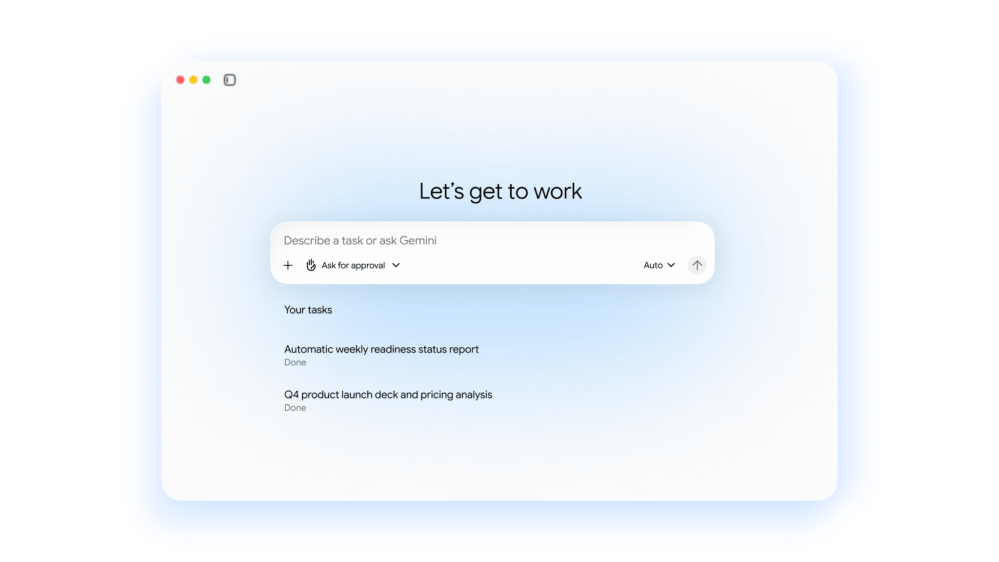
Thomas Kurian, CEO of Google Cloud, emphasized a fundamental shift in how users interact with the software. Instead of providing granular, step-by-step instructions, users can now assign high-level "objectives." The AI is then empowered to plan its own roadmap, utilize specialized tools, and interface directly with internal corporate systems to achieve the desired outcome.
In a move that signals a more open ecosystem, Google is introducing a "model picker." While the AI will automatically select the most efficient model for a task, users can manually override this choice. Notably, this includes support for third-party models, starting with Anthropic’s Claude, with plans to integrate open-source and private models in the near future.
The technical integration capabilities are vast. The agent can bridge data across platforms including Google Workspace, Microsoft 365, Slack, Jira, and various heavy-duty data warehouses like Snowflake and BigQuery. It is also designed to work securely with Model Context Protocol (MCP) servers, ensuring it can operate within complex, protected corporate networks.
One of the most intriguing features is the agent’s "identity." Google is treating the AI as a legitimate team member; it will possess its own Workspace account, email address, and contextual awareness of company hierarchy, time zones, and approval workflows. Users can interact with it as easily as a human coworker—tagging it in chats, emailing it, or adding it to group threads. To maintain accountability, every action taken by the agent is recorded in a dedicated audit trail.
For those managing multiple workflows, a new "tasks inbox" provides full transparency, allowing users to monitor the AI’s reasoning process, how it delegates tasks to sub-agents, and its real-time progress.
Early testing has already been conducted by industry leaders such as PayPal, Shopify, and On. As businesses look to balance power with profitability, Google is also introducing new financial controls, including real-time spend caps and smart routing, to help enterprises manage the costs of multi-model orchestration.





Leave a Comment