
Hustler Words – The United Nations has embarked on a significant technological collaboration with Google, announcing a new initiative aimed at transforming its vast repositories of global statistics into an easily accessible format for advanced artificial intelligence systems. This strategic partnership seeks to bridge the gap between burgeoning AI capabilities and the authoritative, granular data essential for informed decision-making worldwide.
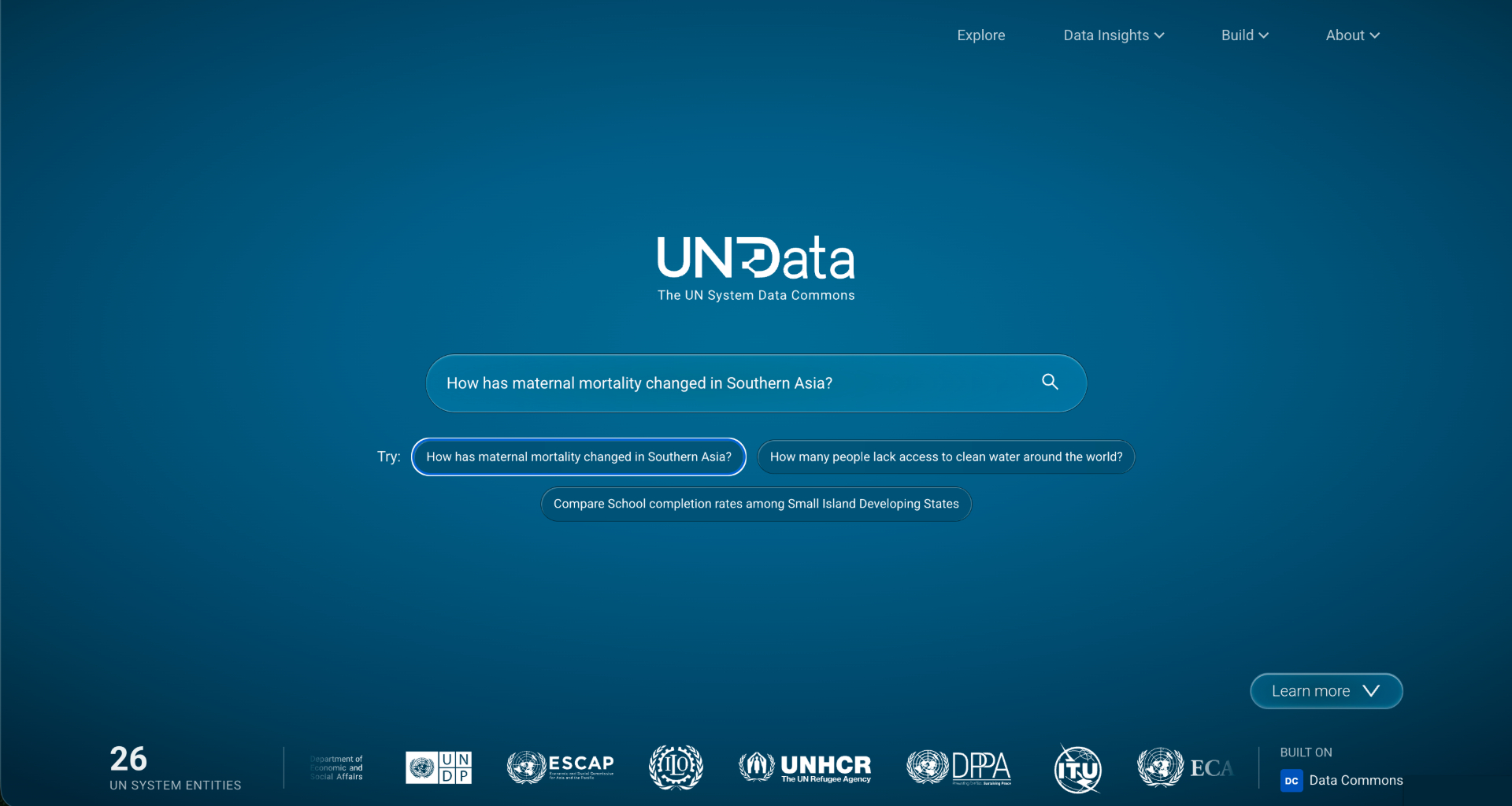
Dubbed the UN System Data Commons, this innovative platform is engineered upon Google’s established open-source Data Commons framework. It promises a paradigm shift from traditional database navigation, allowing users to query statistics from numerous UN agencies using intuitive natural language. This marks a substantial upgrade from the previous UNData portal, which relied on a more conventional interface. Crucially, the new system integrates the Model Context Protocol (MCP), a standard designed to facilitate direct connections between AI systems and external data sources.
The urgency for such a system is underscored by current limitations in AI’s ability to reliably surface credible information. João Pedro Azevedo, UNICEF’s chief statistician, revealed in a virtual briefing that a recent UNICEF benchmark study, evaluating six prominent large language models (LLMs) across over 133,000 responses to global development indicator questions, yielded a dismal average accuracy score of merely 21.2%.


The comprehensive test involved leading AI models, including OpenAI’s GPT-4o and GPT-4o-mini, Anthropic’s Claude Sonnet 4.5 and Haiku 4.5, and Google’s Gemini 2.5 Flash and Gemini 2.0 Flash, as reported by hustlerwords.com. Azevedo highlighted that approximately three out of five responses failed to provide any usable numerical data, often due to the models’ tendency to hedge their answers. Furthermore, a troubling inconsistency emerged: when the same questions were re-run on the identical model versions just two days later, models that had previously provided a number only returned the exact same figure about half the time.
This UNICEF study, currently a working paper slated for journal submission and awaiting peer review, plans to make its methodology, code, and data publicly available. Coinciding with these findings, UNICEF has observed a dramatic increase in traffic from generative AI assistants to its data website this year, which typically garners over 6 million monthly visits. Referrals originating from ChatGPT answers alone surged by 67% year-over-year between January 1 and September 14, Azevedo informed hustlerwords.com, with such links accounting for 6.4% of all sessions. Overall, AI assistants are now estimated to drive roughly one in ten visits to the site.
The UN has confirmed that 26 of its entities have committed to integrating with the Data Commons, with nearly 20 already providing data at launch. The ambitious goal is to onboard 80% of the UN system’s statistical datasets onto the platform by 2027. Shantanu Mukherjee, acting director of the UN Statistics Division, emphasized the unprecedented scale and flexibility of this initiative, stating, "We are orders of magnitude more advanced in scale, scope, and flexibility, connecting for the first time across so many agencies across the UN system… And [we are] taking this moment to also make our data AI-ready."
Google.org has provided substantial support, contributing $2 million in capacity-building funds and technical assistance to establish the platform’s foundational infrastructure. Prem Ramaswami, who spearheads Google’s Data Commons team, shared with hustlerwords.com that the system operates on a UN-governed instance, with the long-term vision for the UN to independently maintain, operate, and scale it.
Ramaswami noted Google’s "train-the-trainer" strategy throughout the rollout, observing that the UN system team has rapidly gained proficiency. Google initially launched Data Commons in 2018 as an endeavor to standardize public datasets from diverse origins into a unified framework, later adding MCP support last year to enable direct querying by AI agents.
A crucial feature of the UN’s new platform is its meticulous tracking of data provenance, allowing users to trace any statistic retrieved by an AI system back to its original UN source. Azevedo highlighted the paramount importance of this traceability as reliance on AI tools for information retrieval and interpretation continues to grow.
Beyond facilitating the retrieval of individual statistics, Google showcased the platform’s potential by demonstrating how an AI system, connected to UN data via MCP, could synthesize multiple indicators to generate comprehensive dashboards, charts, and written analyses without manual data compilation. One compelling demonstration involved an AI system tasked with assessing the impact of the U.S. President’s Emergency Plan for AIDS Relief in Africa. The system adeptly identified relevant UN statistics, such as HIV infections, AIDS mortality, and life expectancy, to produce an insightful infographic.
However, providing AI systems with authoritative data does not automatically guarantee authoritative conclusions. Ramaswami cautioned, "Because models can misinterpret nuance, a human should always review the outputs before citing or publishing them," underscoring the indispensable role of human oversight in the age of AI-driven insights.


Leave a Comment